Free online travel guide to Munich, Bavaria & Germany. Latest news and visitor information on tourist and sightseeing attractions, opening times, admission charges, entrance fees, the Oktoberfest, the Olympics, hotels, beer halls, beergardens, breweries, restaurants, bars, nightlife, shopping, events, public transportation, bus tours and excursions. With lots of pictures and videos. All sights at a glance. Brought to you directly from Munich.

Showing posts with label 2. ATTRACTIONS. Show all posts

Munich: Bavarian National Museum [Bayerisches Nationalmuseum]


Munich
Bavarian National Museum [Bayerisches Nationalmuseum]

The Bavarian National Museum is one of the most important museums of decorative arts in Europe and one of the largest art museums in Germany. Since the beginning the collection has been divided into two main groups: the art historical collection and the folklore collection.

The museum was founded by King Maximilian II of Bavaria in 1855. It houses a large collection of European artifacts from the late antiquity until the early 20th century with particular strengths in the medieval through early modern periods.

The building, erected in the style of historicism by Gabriel von Seidl 1894-1900, is one of the most original and significant museum buildings of its time. It is situated in the Prinzregentenstreet, one of the city's four royal avenues. 

The main building of the Bavarian National Museum includes on three floors exhibition rooms with in total about 13,000 square meters. The core of the collection dates from the art collection of the Wittelsbach family. This gives the National Museum an importance far beyond the local area. Diversity and breadth of the collections, however, were particularly motivated by the new additions to the subsequent period. To date, the inventory is updated continuously not only through acquisitions, but also by significant foundations and bequests. Support experienced by the National Museum, in particular, by the 1960 launched club "Friends of the Bavarian National Museum".

The National Museum has several branch museums throughout Bavaria. A new building behind the museum houses as addition the Bavarian State Archaeological Collection (Archäologische Staatssammlung) from the first settlement in the Paleolithic Ages through the Celtic civilization and the Roman period right up to the early Middle Ages.

For more information about the Bavarian National Museum <please click here>.

Location: Bayerisches Nationalmuseum,


http://munich-travel-guide.blogspot.com - Always worth a visit!
Munich, Germany Weather Forecast

Munich: The Käfer Delicatessen Store

Munich
Käfer Delicatessen Store

Looking for delicious food from Munich, Germany? Visit the Käfer Delicatessen Store! It is located on 1,200 m² on the ground floor and in the basement in the Käfer Group headquarters at Prinzregentenstraße 73. Käfer carries around 8,000 articles, including, for example, over 350 kinds of cheese, 800 wines and spirits and 50 different kinds of meat. But you can also simply buy a delicious brezel and a coffee-to-go at this place and make yourself comfortable on one of the relaxing seats in or outside the shop. Of course you will also find a Käfer restaurant ("The Käfer Schänke") right next to the shop.

For more information about Käfer <please click here>.

Location: Käfer, Prinzregentenstraße 73, 81675 München, Germany

Location on the map: <please click here>
 

http://munich-travel-guide.blogspot.com - Always worth a visit!
Munich, Germany Weather Forecast

Munich: Olympic Village Student Quarters


Munich
Olympic Village Student Quarters

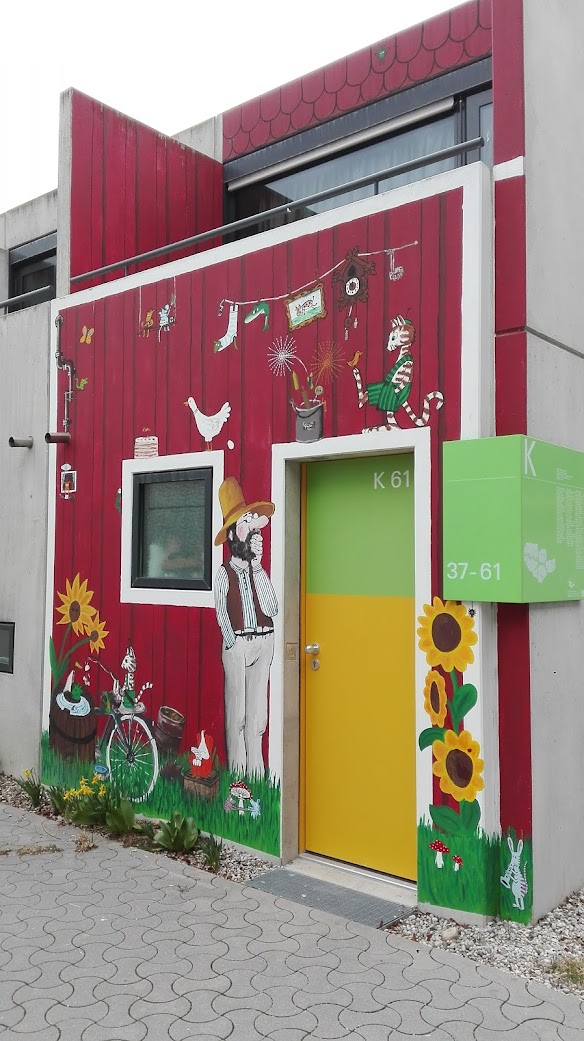
Students have been living in the former women's olympic village since 1972. The bungalows were rebuilt between 2007-2009 and students moved back in, in autumn 2009. 

The Olympic Village (so-called "Olydorf") used by students consists of three living areas.On the one hand these are the 1052 (formerly 800) individual bungalows. Characteristic was (and now is again) the painting of the bungalow doorways and facades, which was an expression of European youth culture. The refurbishment of the bungalows for the European Athletics Championships in 2002, when the student village was once again inhabited by athletes, inter alia exchanged the doors, so the painting was partly lost. The bungalows were a very popular housing form before the renovation work began. The mini-houses newly built with reinforced concrete parts are essentially based on the original bungalows from 1972. Werner Wirsing, one of the old architects, was involved in the planning for the new construction of the bungalows. The residents have a two-storey duplex apartment, which has a kitchenette, bathroom and terrace. In addition, every new inhabitant again has the right to design the façade of his bungalow himself.In the high-rise building (Haus A and B) at the Helene-Mayer-Ring 7, 801 students live in single apartments, each with their own kitchenette, bathroom and after conversion without balcony. After the rehabilitation of the bungalows, the high-rise was renovated from 2010 to 2012.
In addition there are around 100 residential units in family apartments in Connollystrasse 7 to 11, which are inhabited by young families with or without a child.
  
There is lots on offer here, not least by the „Olympic Centre Students Association“, which has already passed its 40th year of existance. 

For more information about the Students´ halls of residence <please click here>.


Location: Olympic Village 1972, Connollystr. 3, 80809 Munich, Germany


http://munich-travel-guide.blogspot.com - Always worth a visit!
Munich, Germany Weather Forecast

Munich: Museum Villa Stuck


Munich
Museum Villa Stuck

The Villa Stuck is a national and internationally renowned place of encounter with art from the 19th to 21st century. A significant collection of works by Franz von Stuck (1863-1928) and international exhibitions on art around 1900, as well as modern and contemporary art, make the Villa Stuck a unique place of art.The Villa Franz von Stucks (built 1897/1898) unites luxurious room settings, a representative artist's living and private living. The Villa Stuck was celebrated by his contemporaries as a "modern," but individual, sensation. At the Paris exhibition in 1900 the furniture, which the artist had specially designed for his villa, was awarded a gold medal. Through a new, generous studio building, the artist's workshop was completed in 1915. On the back of the villa is an artist's garden, which combines Pompeian models with works of art of the 19th century.The overarching principle of the artist's workshop is the total work of art, in which life, architecture, art, music and theater combine. Against this backdrop, the current programs of Villa Stuck highlight the artistic and cultural diversity of the 19th to 21st century. Art labs, exchange exhibitions and collections enter into a fruitful dialogue. The Villa Stuck is thus also a source of inspiration and artistic exchange as well as a store of knowledge - a place open to all visitors.Since 1992 the Museum Villa Stuck has been a museum of the city of Munich and as such a foundation of the state capital Munich with donation Hans Joachim and Amélie Ziersch.

For general visitor information (opening times, how to get there, etc.): <please click here>

To see this location on the map: <please click here> 

Location: Museum Villa Stuck, Prinzregentenstr. 60, 81675 München


http://munich-travel-guide.blogspot.com - Always worth a visit!
Munich, Germany Weather Forecast

Munich: Prince Regent Theatre [Prinzregententheater]


Munich
Prince Regent Theatre [Prinzregententheater]

The Prinzregententheater is a famous theatre and opera house located at  Prinzregentenplatz.

The theatre was built  as a festival hall for the operas of Richard Wagner near an area where a similar project of King Ludwig II had failed some decades before. Named after Luitpold, Prince Regent of Bavaria the building was designed by Max Littmann and opened 21 August 1901 with a production of "Die Meistersinger von Nürnberg" by Richard Wagner.
The Prinzregententheater suffered damage during World War II which was not repaired until 1958. Since its renovation in 1988, the Prinzregententheater, with 1122 seats, has served also for the Bavarian Staatsschauspiel and now houses the Bavarian Theatre Academy founded by August Everding.

For general visitor information (opening times, how to get there, etc.): <please click here>

To see this location on the map: <please click here>

Location: Prinzregententheater, Prinzregentenplatz 12, 81675 München


http://munich-travel-guide.blogspot.com - Always worth a visit!
Munich, Germany Weather Forecast

Munich: The Bavarian State Chancellery [Staatskanzlei]

 
Munich
The Bavarian State Chancellery [Bayerische Staatskanzlei] 

The Bavarian State Chancellery is a state agency of the German Free State of Bavaria.

Bayerische Staatskanzlei is also the name of the building in Munich-Maxvorstadt that houses the personal offices of the chancellery staff. It was erected from 1989 to 1993 around the central dome of the fomer Bavarian Army Museum, which had been built in 1905 at the site of the Hofgartenkaserne barracks and was demolished in World War II.

To learn more about it: <please click here>
For general visitor information (opening times, how to get there, etc.): <please click here>
To see this location on the map: <please click here>


Munich, Germany Weather Forecast
-->
Posted by Picasa

MUNICH: SCHRANNENHALLE (FOOD MARKET)

Munich: Food Market at Schrannenhalle (next to Viktualienmarkt)
The Schrannenhalle south of Viktualienmarkt shines in a new light: On 13 October 2011 Mayor Christian Ude opened together with the new owner of the hall, Hans Hammer, the so called Schranne as a market hall with a variety of culinary offerings. 30 food stalls offer their unique products in the historical building in the heart of Munich. Watch the video below to get some impressions of this outstanding attraction. 
Location: Munich, South of Viktualienmarkt   
Free online travel guide to Munich, Bavaria & Germany. Latest news and visitor information on tourist and sightseeing attractions, opening times, admission charges, entrance fees, the Olympics, the Oktoberfest, beer halls, beergardens, restaurants, bars, nightlife, hotels, shopping, events, public transportation, bus tours and excursions, surrounded by many pictures, videos and useful tools.
Directly from Munich. All you need to know. At a glance.
http://munich-travel-guide.blogspot.com - Always worth a visit!
Munich, Germany Weather Forecast

MUNICH: GASTEIG

GASTEIG: Munich's cultural and educational center

In the 2011 season the Gasteig celebrates its 25th anniversary. Since its opening in 1985 it has become a center of cultural life in Munich. It is home to renowned cultural and educational institutions of the city of Munich and owes its name to its location: On "Gachen Steig", central and highly visible on the right banks of the Isar.
Program
With more than 1,700 events a year the Gasteig provides a colorful and diverse program. It ranges from computer courses to the Jazz Film Festival or the pharmacist Congress to Beethoven's Eroica.
Opening times
From 8 a.m. to 11 p.m. the Gasteig opens the doors for nearly 6,000 visitors daily. Munich's cultural and educational center is designed as a meeting place. With its many halls, work rooms and foyer areas, it is open to all who wish to get engaged in intellectual and artistic forms of expression.
Venue
In addition to the established in-house program offered by the local institutions, the public can perceive many cultural offers. Last but not least, the special ambience of the Gasteig is also the perfect setting for anniversaries, meetings, conferences and product presentations.
Architecture
The architecture of the red brick building connects external coherence and clarity of inner lines with openness of interior design - the result of a consistent selection of construction materials and colors.

Location: Rosenheimer Straße 5, 81667 München


Free online travel guide to Munich, Bavaria & Germany. Latest news and visitor information on tourist and sightseeing attractions, opening times, admission charges, entrance fees, the Olympics, the Oktoberfest, beer halls, beergardens, restaurants, bars, nightlife, hotels, shopping, events, public transportation, bus tours and excursions, surrounded by many pictures, videos and useful tools.
Directly from Munich. All you need to know. At a glance.
http://munich-travel-guide.blogspot.com - Always worth a visit!
Munich, Germany Weather Forecast

MUNICH: HOSTAGE DRAMA IN THE OLYMPIC VILLAGE 1972

During the Olympic Summer Games in Munich in 1972 Palestinian terrorists attacked the Israeli team in its housing inside the Olympic Village (31 Connollystreet). Altogether 17 people died. The attack is often referred to as the Munich Massacre. The Palestinian terrorist organization Black September took eleven athletes of the Israeli team hostage. Two of the hostages have been murdered already in the Olympic Housing. In a failed rescue attempt all the other hostages, a German policeman and five terrorists were killed later at the Furstenfeldbruck airport. The building where the attack took place is almost unchanged today. You will find a memorial plaque in front of the former headquarters of the Israeli team at Connollystraße 31.


2012/09/05, Connollystr. 31, exactly 40 years later


Free online travel guide to Munich, Bavaria & Germany. Latest news and visitor information on tourist and sightseeing attractions, opening times, admission charges, entrance fees, the Olympics, the Oktoberfest, beer halls, beergardens, restaurants, bars, nightlife, hotels, shopping, events, public transportation, bus tours and excursions, surrounded by many pictures, videos and useful tools.
Directly from Munich. All you need to know. At a glance.
http://munich-travel-guide.blogspot.com - Always worth a visit!

MUNICH: WITTELSBACH FOUNTAIN (WITTELSBACHER BRUNNEN)


WITTELSBACH FOUNTAIN AT LENBACH SQUARE (German: Lenbachplatz)
Wittelsbach Fountain is a monumental fountain on the north-western edge of downtown Munich, the transition from Lenbach Square to Maximilian Square near the Munich Stock Exchange. It was built between 1893 and 1895 according to plans by the sculptor Adolf von Hildebrand in the style of classicism. His subject is an allegory of the primordial forces of the element of water. With respect to the calm and clear design as well as among urban aspects the fountain is considered one of the most artistically accomplished facilities in the Bavarian capital.
The rediscovery of the aesthetic design principles of classical antiquity in the first half of the 19th Century brought a return to the fountains of Renaissance art. The fountain should serve as a transition between Karlsplatz Square and Maximilian Square, the present Lenbach Square, and was supposed to be built on the remains of the old city walls.
The fountain was donated by the City of Munich, who wanted to celebrate the completion of a new high pressure line from the Mangfall Valley to supply the citizens with drinking water in 1883. After almost two years of work the unveiling of the fountain took place on 12 June 1895.
For Hildebrand, the Wittelsbach Fountain was the first in a series of five monumental town fountains.
During the Second World War the plant was badly damaged and after the war by the sculptor and pupil Theodor Georgii Hildebrand restored. On 3 October 1952 the well was put into operation again.
The left figure shows a young man riding a water fish-tailed horse, as it emerges from the floods. With both hands he holds a rock with which he prepares to throw. Hildebrand created with the figure an allegory on the destructive power of water, an allusion to the unbridled force of mountain streams.
The right figure shows an Amazon. She sits on a fish-tailed marine animal. With her left hand stretched out towards the viewer with a bowl of water. This figure symbolizes the fruitful and healing power of water.
Operation / Illumination
The fountain is illuminated around the clock, except on sunny days.
Location: Munich, Lenbach Square (German: Lenbachplatz)


Free online travel guide to Munich, Bavaria & Germany. Latest news and visitor information on tourist and sightseeing attractions, opening times, admission charges, entrance fees, the Olympics, the Oktoberfest, beer halls, beergardens, restaurants, bars, nightlife, hotels, shopping, events, public transportation, bus tours and excursions, surrounded by many pictures, videos and useful tools.
Directly from Munich. All you need to know. At a glance.
http://munich-travel-guide.blogspot.com - Always worth a visit!

MUNICH: DALLMAYR - FINEST FOOD


Dallmayr is a luxury delicatessen food store in Munich, Germany, dating back to the 17th century. Its reputation is comparable to Fauchon in Paris, Fortnum & Mason in London, or Meiji-ya in Tokyo. About 2.5 million people visit the main store every year. Besides luxury food, Dallmayr also sells a luxury brand of coffee, includes a restaurant, a party service, and other food related services. The revenue of 2004 was 455 million euro with about 2,500 employees. The main competitor in Munich is Feinkost Käfer.

The main store, completed in 1950 with a neo classic facade, is located in the Dienerstrasse in Munich between the Marienplatz and the Odeonsplatz. About 2.5 million people visit the main store every year, including VIPs and tourists. (Other sources state 1.3 million people per year, which in any case are still more than Neuschwanstein with 1.1 Million). The list of regular customers includes Queen Sirikit Rajini of Thailand. Besides the first-rate food, the store is also known for its indoor fountain, stocked with live crayfish. Different from a supermarket, there is no central cashier, rather the products are always purchased in the individual departments. The building is known Germany-wide due to the Dallmayr television advertising, prominently featuring the building since 1980, including the staff in blue blouses and white aprons and the historic porcelain vessels. Having a TV spot run three times per day costs the company about 20 million euro per year. Currently, a staff of about 300 is employed in the main store.
On June 29, 2003, Dallmayr opened its first branch store in terminal 2 at the Munich International Airport, a combination of shop and cafe-bistro-bar for 160 people.
The main store dates back to the 17th century, with a Spezereien-Handlung of the Munich citizen and chandler Christian Reitter. The store was established in the current location in the Dienerstrasse between 1671 and 1700. The exact date is not known, a surviving document dates from his death in 1700. After his death his two daughters inherited the store and the chandler guild membership. The name Dallmayr comes with a new owner in 1870, Alois Dallmayr, a merchant from Wolnzach in Bavaria. Alois Dallmayr did not have any heir and therefore in 1895 sold the store to Anton Randlkofer, who died only two years later.
His widow Therese Randlkofer took over the store. While a female top executive was very rare during these times, she managed the business very successfully, and significantly improved the reputation of the store. She was also very skilled in leveraging social contacts for her business, and exchanged recipes with the cooks of the Bavarian court. Around 1900 the store was one of the top food stores in Europe, and its customers included 15 royal and noble households in Europe, including the last German Emperor Wilhelm II of Germany. (One of these 15 was already a customer during the times of Alois Dallmayr, the other 14 became customers during the management of Therese Randlkofer. The numbers also vary slightly with different sources). The store was also awarded the title of Königlich Bayerischer Hoflieferant (Royal Bavarian Purveyor to the Court), and made daily deliveries for Prince Luitpold of Bavaria. The store was also the first store to import bananas from the Canary Islands to Germany, and also offered mangos, plums from China, and lychees during a time when most people had never even heard of bananas. Therese Randlkofer introduced many innovations. For example she used otherwise unsellable corners of larger bacon pieces for salads on a salad bar, hence opening the first cold buffet. The store was also the talk of the town for its modern illuminated advertising. Therese Randlkofer purchased an estate in 1906, the Goldachhof near Ismaning to provide supplies for the store. By 1912 the store had more than 70 employees.
In 1930, due to the depression after the Wall Street Crash of 1929, Dallmayr also encountered difficult times, as especially the purchase of luxury products decreases in a depression. To protect against a downturn, Dallmayr expanded its product portfolio in 1931 to include a new product line, coffee. By 1933, a full fledged coffee department including electric roasting has been established by a 19 year old coffee Expert Konrad Werner Wille from Bremen.
During the devastation of World War II, the main store was completely burned down to the ground in 1940. The coffee division also encountered difficulties, as coffee was only available on the black market. The current owner Paul Randlkofer, grandson of Anton and Therese Randlkofer, and his coffee expert Konrad Werner Wille start rebuilding, partially financed by the sale of the Goldachhof near Ismaning. By 1950 a new store was completed according to the historic plans including the facade. They also expand the business further by including a vending machine service around 1960, initially in cooperation with BMW. During this time, Konrad Werner Wille also developed a new brand of coffee, Dallmayr Prodomo, which became a big success and is still available today. After the death of Konrad Werner Wille in 1977, his son Wolfgang Wille and Georg Randlkofer took over the management of the business. In 1984 Nestle purchased a 50% ownership of the coffee division to establish a foothold in the German coffee market. In 1985, the coffee division is established as a separate company under Wolfgang Wille, the Alois Dallmayr Kaffee oHG. In August 2003 Nestle reduced its share of the Alois Dallmayr Kaffee oHG to 25%. Today Dallmayr is a premium brand name in Germany. As there is no Bavarian court anymore, the company states itself as Ehemaliger Königlich Bayerischer Hoflieferant (Former Royal Bavarian Purveyor to the Court).
(from Wikipedia, the free Encyclopedia)


  ____________________________________________________________________     


Free online travel guide to Munich, Bavaria & Germany. Latest news and visitor information on tourist and sightseeing attractions, opening times, admission charges, entrance fees, the Olympics, the Oktoberfest, beer halls, beergardens, restaurants, bars, nightlife, hotels, shopping, events, public transportation, bus tours and excursions, surrounded by many pictures, videos and useful tools.
Directly from Munich. All you need to know. At a glance.
http://munich-travel-guide.blogspot.com - Always worth a visit!


MUNICH: HOUSE OF ARTISTS AT LENBACH SQUARE (KÜNSTLERHAUS AM LENBACHPLATZ)


The House of Artists on Lenbachplatz in Munich is a kind of club house of the Munich artists.
The idea for the project "art house" was created in the 19th Century in the vicinity of Munich's artistic community created pranks. The building was designed by Gabriel von Seidl and, after laying the foundation stone in 1893, inaugurated in 1900 by Prince Regent Luitpold. Artists' parties, masked balls and banquets, arranged in part by the artists Franz von Lenbach, Friedrich August von Kaulbach and Franz von Stuck, it became the encounter between art and society.
Under the Nazi Regime the House of Artists Association was disbanded. Instead a so called "fellowship of artists" set up. On 14 July 1944 the house burned down in consequence of a bomb attack. After the war the property was seized by the Americans in 1954 and returned to the Munich art-house club. After reconstruction by architect Erwin Schleich Künstlerhaus the Künstlerhaus was reopened on 1 October 1961 by Duke Albrecht of Bavaria and the Mayor Hans-Jochen Vogel. In 1998 a general renovation took place.


    Free online travel guide to Munich, Bavaria & Germany. Latest news and visitor information on tourist and sightseeing attractions, opening times, admission charges, entrance fees, the Olympics, the Oktoberfest, beer halls, beergardens, restaurants, bars, nightlife, hotels, shopping, events, public transportation, bus tours and excursions, surrounded by many pictures, videos and useful tools.
    Directly from Munich. All you need to know. At a glance.
    http://munich-travel-guide.blogspot.com - Always worth a visit!